Showing posts with label bureacracy. Show all posts

Sunday, January 1, 2012

אז למה את לא גרה בארץ? The Land.

טוב לזכור שאני לא היחידה בעולם. טוב ליראות כיפות, ונרות חנוכה, והשמש ירושלמי. טוב לשמוע עברית. טוב להיות בארץ


Absurd and utter culture shock. Icy winds of 5° changed to balmy breezy 15°. Political politeness shifted to fanaticism-driven lawbreaking. Passersby transformed from reserved strangers to rollicking, friendly family. Even the moon is in the wrong place, and has climbed higher in the sky, aloof above the palm trees.


At the Kotel (Western Wall)
Arriving in Israel was comfortable, and familiar, and a good regular mind blip. I arrived at 2 am to a country that speaks my language, shares my religion, and gives me my history. The nesher (cab) driver shocked me completely—when the guy sitting in front of me tried to offer him payment, he turned and said, “can’t you see I’m driving?” Granted, he did turn around completely, but the refusal to multitask while driving represents a complete shift in Israeli cabby mentality. We drove through Ramot and Geulah first, and I got to remember the uncomfortable part of Israel too: huge signs saying “Women and girls, please dress modestly” (can you think of a more subtle way to tell someone they’re only a body? The advertisers who use women's curves to sell beer and charedim who insist women cover up every last inch of skin possess one thing in common-- they both think of women only as sex objects. They just have different reactions to it) and smaller signs saying “No Zionists.” Well, I don’t like you either. 


Disclaimer: I thought about translating and explaining every piece of this to those not familiar with Israel or Hebrew, and then gave a huge mental shrug and decided it would lose some flow and integrity if I did. המבין יבין. And everyone else is free to ask questions in the comments which I will answer thoroughly.


Hooded against the Israeli sun
We pulled up at my Bubby’s apartment and I woke my mother and got the hug I’ve been missing for four months. She did a quick check for new piercings and then returned to sleep.

Friday was lovely—my parents, baby sister and I went down to the biblical zoo, where they only host animals mentioned in Tanach. Lots of antlered creatures that would have been bloody sacrifices 200 years ago. We had sufganiyot (jelly- and caramel- and chocolate- filled donuts) as a pretaste of Chanukkah yumminess. Then our cousins from Ramat Beit Shemesh came in, and the apartment devolved into pre-shabbat chaos.

The kids have had a bit of trouble placing me this year when we skype. My aunt asks them:
Do you know where Hannah is living this year?
Blank stares.
Norvegya!
More blank stares.
אמא, איפה נורווגיה?
בצפון.
Oh! Suddenly they get it. על יד החרמון?
Face-palm.

Moriah, six-years-old-going-on-twelve, asked me how long it took to get to Israel from Norvegya.
“ten hours,” I told her.
“אז למה את לא גרה בארץ?” she asked. She’s been well-trained. Cue the guilt trip.

Shabbat was full of the zemirot and chicken/cholent/beef and family that I’ve been missing. I bumped into old Bnei Akiva friends, and walked with my family down to Gan Sacher past the old monastery, and up into the Hebrew Museum’s sculpture garden, and checked out the Ramat Gan campus of Hebrew University (where my baby sister may live next year). Sunday my middle sister came in from the States, and we did a mid-intersection sisterly hug smack in the middle of Emek Refaim. Monday we headed down to Eilat for our vacation. We meant to stop for a hike on the way, but as we were about to drive down the dirt road, we saw a sign that said “shetach aish” (firing zone). After a lengthy family discussion about the age of the sign, the likelihood that the Israeli army would actually be practicing here, and something from my mom on how she’d do it if it was just her and my dad but with the three of us the risk was too high, we decided not to hike. Which turned out to be a good idea, judging by the herds of tanks engaged in training exercises that we passed as we continued. Instead, we stopped at Timna Park and  walked through and up and between all the strange rock formations.

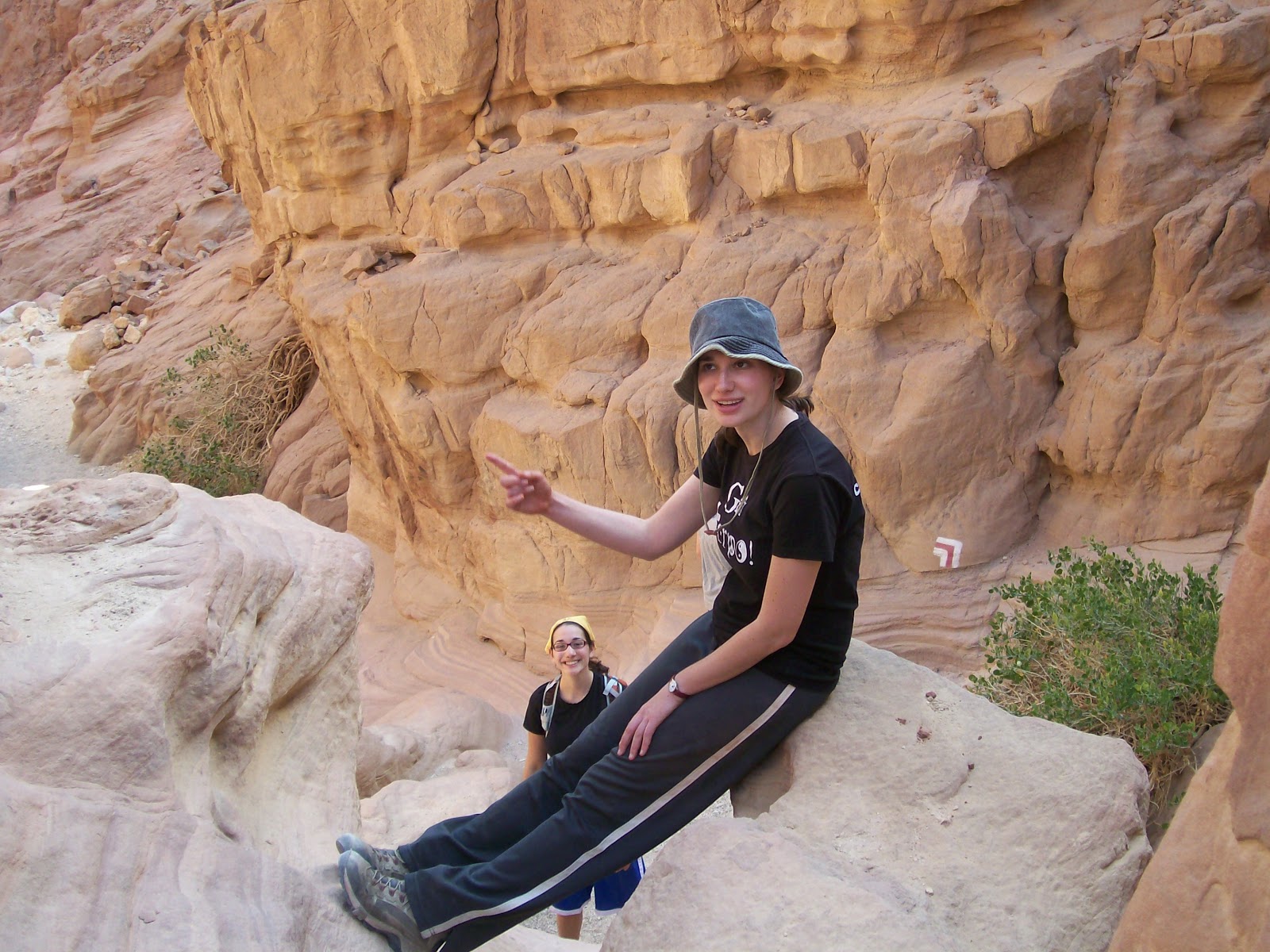
Tuesday we hiked Emek HaNeelam, the Disappearing Valley (is that it? No, I think it’s that one. Wait, this one! They were all disappearing valleys). We wound between the red, purple, white, and black mountains of Eilat and up and down its fantastic rock formations and tried out the echoes. We skidded down futuristic moonscapes and sent cascades of rock showering down to join its brothers. My dad told me not to climb so much, I was destroying the nature, so I explained to him the law of conservation of mass and that all of it would still be here for future hikers, and that his attachment to surface appearance is troubling and indicative of the influence of shallow materialistic society. Then we headed back to the shore where we swam by the coral reef. A fish bit my leg so that blood poured down whenever I left the water. Still worth it. And kind of cool to have a battle wound from coral reef gazing. 

That night I finally got around to checking what I need to apply for my Canadian passport next year (born in Montreal, I of course have citizenship, but a Canadian passport will come in handy as a student at the U of T). I ended my frustrating search by sending an email to the embassy that ended with “How can I apply for my social number so I can apply for my ClicSEQUR account so I can apply for my birth certificate so I can apply for my passport?” It was with great difficulty that my sisters restrained me from tagging an “F you” onto the end of that, but I think it may have been implied in the question.

Wednesday we did the hike we wanted to do on Monday, Nachal Adah. My dad called the IDF and checked, and they said there’d be no firing practice during Chanukkah. You’ve got to love a country that runs on the same schedule as you. Anyhow, the first ten minutes of the hike was a hellish jog through increasingly narrow canyon walls which I don’t remember scrambling out of but must have practically spat myself out through onto a plateau way higher than the actual trail. Once they caught up, my parents talked a bit about paying for therapy to help me with my claustrophobia, but since the only big problem it causes is them having to hurry along a trail, I really don’t think it’s worth it (plus, wouldn’t they put me in small spaces to accustom me to it?). And at least I could stride along the narrow ridge of the mountains for several hours afterwards, relieved and relaxed while several thousand meters in the air.

At the restaurant that night, chabadnicks entered and lit a chanukkiah with the waiters, singing “haneirot halalu” with off-key energy. A young girl in tight jeans jumped up and started to sing and bounce by the candles. Te looked and said “uh-oh,” and we all burst out laughing.

Shabbat in Jerusalem again. Friday night we davened at Shirach Chadasha, and it was the first time in six months I was actually in a synagogue. European shuls usually relegate their women to balconies in the manner of an audience at the Globe Theater; they haven't quite reached the twenty-first century yet (to be fair, neither have some shuls in the Gush). Shabbat morning we went to Yakar, which I love for the melodies and the mix of Israeli-American-young-old-shtachim-styles-conservative-dress, and the break for shiurim after Torah reading.


There is a peculiar magic to Jerusalem. You bump into your entire past here: friends from high school, Bnei Akiva, midrasha, university… Normally this drives me crazy, but the gods of serendipity must have been watching out for me, because I ran into the best of every era of my life: my closest friends from Maryland, favorite Orot Israeli, funniest Bnei Akivaniks, and the Nishmater with the driest sense of humor. Thank you, ye gods.

After my parents left the country, my sisters and I went up to Haifa to see our favorite Israeli family friends. They’re highly educated yet super-chill. Yoni’s a prof at the University and gave us a tour, showing us the 400 BC Phoenician boat that was dragged up from the harbor and now sits in the archaeology museum, and the view of all Haifa from the university tower. U of Haifa held streams of students that filled a gap that nags at me in Bergen: diversity. In Haifa, students in hijabs passed the students tanning in mini skirts while students holding their kippot to their heads rushed between the two. I heard Hebrew, Russian, French, and Arabic, and skin colors ranged from pale pearly to deep bronze. I’m not usually acutely conscious that Bergen lacks this kind of human mix, but some part of me keeps scanning the crowd for the normal difference that I’m used to.

A Bahai friend of mine from college is in Israel for two years volunteering at the Bahai temple in Haifa. When he heard I was coming, he offered a private tour through the gardens. We got to pump him with questions about the Bahai faith (no ritual, a goal of working to create spiritual communities regardless of their being Bahai or other faith, no women on the Justice Board (!), international presence, and the thing about only Bahai walking up the terraces is a myth, we walked upwards). Ben would make a good representative of any religion. He’s composed and kind, quiet and yet unpretending and casual. He showed us the Ark, the gated section where the four buildings that world Bahai work in stand: the archives, education center, textual study, and justice building. I like that as the core of a nation: all the world really needs are schools, courts, and libraries. We also went into the shrine at the bottom of the gardens, which was closed to visitors just then. I asked Ben first if there were any statues in there, and it turned out it was simply an utterly serene space. In the center were different kinds of flowers and lights: trailing plants, blooming petunias and planters of roses, and candelabras of flame or electric light. A delicious aroma perfumed the air. We stood respectfully as Ben sat cross-legged and prayed. A prayer on the wall seemed a blend of the stereotypes of Judaism, Christianity, and Islam: it had one God, sacrifice, and infidels in it. The bit I like best was about God’s creation of humanity. “Be Thou,” He said. And we were.
 
It struck me, as I moved to sit cross-legged on the carpet, that Bahai is the perfect religion for a twenty-first century human. Individualistic prayer, communal social action, based on a desire to help all people achieve spirituality in whatever faith they choose—it contains the perfect amount of world-optimization and nonjudgmental tolerance. Closing my eyes to the symbols of human hope—light and greenery—I breathed in peacefully for a moment, holding only serenity in my mind. Then I thought of the mess that is Judaism, the halachic tangles and the misogyny and the in-fighting and men spitting on little girls in Ramat Beit Shemesh and price tag attacks in the shtachim and women’s faces vanishing off billboards in Jerusalem, and breathed in deeply once more, and walked carefully backwards out of the room. 
 
That night I met up with the Lewis twins and Thea from Nishmat and we went to a concert by an Israeli singer (Amir something). Think Mizrachi rock. He sauntered up to the mike as though it was just luck it happened to be there, and belted out Biblical ballads and love songs. He stopped singing at moments, stroking his beard or adjusting his cap, and let the crowd roar out the words instead. It was half concert, half sing-along. Very Israeli, and we danced in the aisles and pretended to know the words.

My last night in Jerusalem, Te and El and I went to see the second Sherlock Holmes. It’s more fun than in an American theater, because everyone’s whispering, not just us. On the way back we had a loud altercation about the female characters’ relative depth and the feminist response to a cardboard femme fatale, which must have woken every protestor sleeping in a tent in Gan Sacher.
My nesher back to the airport was as positive an experience as my nesher there had been awful. We wound through my favorite streets in Rechavia and Bacca, past balconies of clean Jerusalem stone climbing up the slope, then into an area lost somewhere between the picturesqueness of Nachlaot and the shuk, and finally went down from Yerushalayim by way of Shaar HaGai. Bab El Wad. The Gate of the Valley. Gate av Dalen. My favorite route, that passes the beit knesset that looks like the Beit Hamikdash, and my sabah’s kever on Har HaMenuchot and the memorial to the convoys from 1948. A good way to leave Yerushalayim.


My Abba has this thing about moving big rocks so my Ima can sit comfortably. It's cute, but dangerous.
In Eilat 
Nachal Adah
Kenyon HaShechoret-- Black Canyon
Our lovely penthouse apartment with private pool
Gan HaBotani-- Botanical Gardens
Speak no evil, smell no evil, pick your nose

Five again

Tuesday, November 29, 2011

Hark, Hear the Bells

I don’t know how to talk about the beauty of Bergen at night. Every evening, as dusk sets, fairies tiptoe up the mountains leaving their glitter along the creases in the slopes. The hills are strung with lights and the fjords and lakes in the valleys shimmer with their reflection. Walking through a wild Norwegian night, the wind billowing out my hood and the rain gusting strong against my face, those lights signal cheer and home steadfastness and rosy golden safety. Bergen, where it gets dark by 3 pm, is always a city of jeweled lights on the water.

So, Saturday night, when friends told me about the Bergen Lysfest, or annual Christmas light festival, I was happy to walk up to town and experience some more of the magic. We made it to the Byparken just as they lit the Christmas tree floating out on the lake in the middle of the city. It was simple, a large pine decked with strings of lights and a star at the top, swaying in the wind out on the water. The trees around the fountain had also been festooned with white lights. A huge stage was erected in the plass, and a youth choir soared carols out over the heads of the crowd. Every child had snap-lights and every few adults clustered around a torch that blazed into the rain. In the high-rise buildings around the lake, we could see people on the top floors looking down the same way Americans do for Thanksgiving day parades and the Fourth of July. It felt… like Christmas. Not perfect Christmas, exactly, not Christmas with my family where we go to the zoo and watch the lights along the lake change in time to “Carol of the Bells,” but it was close. Then, the fireworks started. Great, glorious, elegant fireworks that had a shimmering fairy dust sprinkling along the lower edge and exploding pinwheels of color up above. And there were happy face fireworks, which neither Nina nor I had ever seen before. Not to mention it was fireworks in the rain, a feat that I’d believed only the Weasley brothers could pull off. And yet, somehow, it didn’t feel very different from normal Bergen. This city blossoms into a radiant Christmas splendor in the dark every night. Winter night lasts from October to February, and the brilliant glimmer of Bergen’s lights keeps it illuminated, keeps the dark a mere accessory to sheen and shine.


Great news: I just bought my tickets, and I will be in Oslo for the Weekend of Peace. Doesn’t it just thrill you to read those words? I’ve been grading my high schoolers’ latest essays on “their responsibility, as Norwegians, to global democracy,” and I’m all tingly with hope for the future.
Ohio in a nutshell

I gave my guest lectures at Katten today. The Ohio presentation, to Norwegian immigrant high school students, went very well—I had them singing “hang on Sloopy” and shouting “O-H!” “I-O!” at me. The teacher was boggled. She’d never seen them speak that much before, let alone sing and chant Ohioan propaganda. I love my job.

I also gave a lecture on “A (brief) History of Judaism: the Past 4,000 years squeezed into 40 minutes,” to the oldest high school religion class. At one hundred years a minute, I think I got all the major events in. You know, the discovery of monotheism, the beit hamikdash, the Haskalah, and of course the fact that I’m descended from the Alexander rebbe and that Gloria Steinem is Jewish. I left out the names of all the Hasidic dynasties that I memorized in 7th grade. They'll have to learn those somewhere else.

I was particularly nervous about the last slide: the creation of the State of Israel. I wanted to do a number of things: To leave them with a history of modern Israel that would give them an image of something besides the war-torn Middle East, to help them understand that Jewish is not the same as Israeli (a concept a lot of Norwegians have problems understanding), and to be unapologetic about Israel’s right to exist without presenting an entire argument about politics in the middle of my Jewish history presentation. So, this is what I did: I put a gorgeous picture of the Israeli flag billowing in the wind up on the screen, along with the date 1948. I told them that in 1948, the UN voted on the partition plan which created a state of Israel. Then I said that obviously modern Israeli history is not the exact same thing as modern Jewish history, so I’m going to focus on the part that most affects world Judaism. Which was: the Right of Return. I explained that every Jew has a right to citizenship in Israel. Then I gave them a list. I told them about Operation Flying Carpet which rescued 45,000 Yemenite Jews in 1950. I told them about Jews who fled or were expelled from Libya, Lebanon, Syria, Egypt, Algeria, Afghanistan, Iraq, Morocco, Kurdistan, and Tunisia in the years between 1949 and now. I told them about Operation Moses and the airlift of the Ethiopian Jews. And the Soviet Jewish immigration. And the recent immigration of French Jews who are fleeing recent anti-Semitic attacks. In short, without discussing a single Middle Eastern war or concentrating on one ethnicity, I made a compelling argument for the existence of the state of Israel that was in no way politically charged. I felt pretty proud of myself. And you know what? The kids were fascinated. They leaned forward in their seats. They laughed at all the right times. They asked questions afterwards about my personal observance of Judaism. And I knew I’d pulled off quite a good deal. Guess what? I love my job.

I had a meeting afterwards with the professor in charge of the Britlit survey course at UiB next semester. He’s a slouchy, personable Englishman who I like because every so often he pauses and lets me throw in a clever off-the-cuff comment. I’m not sure how the topic was raised, but we went through the basic difficulties of the Norwegian education system. Stuart spoke pretty hopelessly about how profs aren’t allowed to demand student attendance in class—it impinges on students’ rights— and about how there’s not enough resources to create a desperately-needed freshman writing class, and about how little power he as a professor has to teach effectively.

How about a mutual partnership?
Nah, just kidding, I know that's naive.
Now, all this nonsense about students’ rights is really adorable, but the truth is that Norwegian university students, while all have the right to government-funded college education, lack the basic right that American students pay thousands of dollars for: the right to have a professor kick their butts into high gear and challenge the hell out of them. Professors go on and on in the States about how American students treat college as a consumer product and expect to get exactly what they want because they’ve paid for it, but that is nothing to the Norwegian system, where Norwegian students expect, as their legal right, that professors not inconvenience them by demanding too much from them. After teaching a literature survey course which was really more of a methodology course, I’m aching from having passed so many of those students on their papers when I know they’re going to fail the exam. If I could have demanded that they come to class, that they write and rewrite and rewrite their papers and attend special seminars on citation, I could perhaps have brought them up to scratch. But the Norwegian system won’t let. 

I love my job, but sometimes, it gets complicated. 

Wednesday, November 23, 2011

Reading List

New plan: instead of taking out library books, I’m just gonna list what I haven’t read here on my blog and assume they’ll magically show up on my desk in the graduate reading room. Thanks for the Hemingway, Jonas. I also haven’t read Love in the Time of Cholera, Germinal, or Appointment in Samarra. I’ll be expecting them shortly.

For the past week I’ve been running review sessions for my Amlit students. It’s been exhausting and nerve-wracking to be expected to know every single thing about American literature and history, but also exhilarating fun to be tested on my knowledge (“that’s free indirect discourse, too easy, c’mon, ask me another”). I mapped out fake questions for them and then we worked through the answers together. Sometimes they challenged each other, leading to better discussions than they ever had in the seminars. It’s amazing what fear of an exam will do for class participation.

My favorite CMA painting:
The Confused Process of Becoming (Portrait of Roman Johnson)
I also gave a presentation on Rita Dove in my masters seminar on ekphrasis in poetry. I managed to pull from four different Ohio artistic sources—that’s right, we kind of rock (we boast Paul Lawrence Dunbar, William Dean Howell, and Toni Morrison, too!). It was fun to once again give a presentation without worrying about keeping class attention—I could just rocket through the stuff without caring whether anyone was listening or not.

I have a new mailbox in town. The Dead Sea lotion booth on the second floor of the Bergen storsenter is now my drop-box; if you’d like to leave me a message, find the tall guy with spiked hair and an Israeli accent. It’s funny how I keep finding the Israelis, and how weirded out they are by my nationality. Today the series of questions went: “Israeli?” “Oh, then Norwegian?” “Then what?” American?! So how do you speak Hebrew?” Um, did you not notice my accent, dumbbutt? At least they have an extremely accurate grasp on what day school educations can be expected to produce in the way of language skills.

Tomorrow I will experience government bureaucratic idiocy at its finest: both the US and the Norwegian governments will pay me for teaching the same class. Anita’s going to a conference for teachers of Uttøya survivors, so I have the school to myself for the day, and apparently if she passes the keys off to me then I count as a substitute and not a Fulbright ETA, so I get a salary from the Norwegian government in addition to my Fulbright stipend. Viva la Norsk government.

Finally, finally getting homesick as Thanksgiving approaches. I want to be on that plane home stuffed with everyone returning to their families where we clap for the marines as they disembark first. I want hugs and a silly place setting and jokes in bad taste about celebrating American ethnic cleansing and to not watch football and the joy of yams and stuffing and apple pie and cranberry-chocolate tart. So eat a bit of turkey for me, please. Happy Thanksgiving, everyone. 

Monday, August 22, 2011

Fomenting Rebellion

Fomenting Rebellion: Or how I started an uprising at the passport office and almost got thrown out of Norway on the day I received my residence permit

Timeline of events:

Monday, Aug 15:
I arrive at the Police Station early. Take a number from the queue machine. It’s called, and I go to the passport booth to be told that the special student day is Friday. Please come back in a week.

Friday, Aug 19:
8:30     My friends and I arrive at the police station half an hour before it opens. First ones there! We wonder why the queue machine isn’t working
9:00     We start getting antsy.
9:10     The waiting rooms are chockfull of angry students. The Iranians and Africans have crowded at the front (they may have more experience with bureaucracy than the rest of us), but won’t push past the office door.
9:20     I decide this is ridiculous, and requires a healthy amount of American obnoxiousness. I push through the crowd and through the door until I find the passport office. A woman sits behind the glass.

Dialogue between myself and Idiot Lady (IL for short):
Me: Excuse me, ma’am, but I was wondering when the office will open? We were told it  
would open at nine.
IL: It’s open now.
Me: Oh. You don’t think you could have shared that with the hordes of students in your                  waiting room?
IL: What?
Me: Nobody announced it.
IL: Oh.
Me: And the ticket machine that issues queue numbers?
IL: That’s only for normal days. This is a student day.
Me: Ah. But, since there are so many people shoving and pushing outside, don’t you                      think you can start the ticket machine today?
IL: No, that’s just for normal days. This is a student day.
Me: So you have a special day actually designed for the discomfort of students?
IL: (blinks) Well, they’ll just have to wait in line and be disciplined
African student who sticks his head in: Can you ask her what to do if we have to leave                      because we have class at 10?
Me: Some of the students have class at 10. What should they do?
IL: But you’re here already. I can do your passport now. It will be done before 10.
Me: Yes, but the rest of the angry students don’t speak an English as excellently adapted              for arguing with idiot ladies as me (no, I didn’t really say that). What should they do?
IL: They should come back Monday.
Me:  Thank you. Excuse me one moment.
I walked out into the hallway, which magically quiets as I appear.
Bergen Public Library. Went there after the
Police Station to regroup.
 “You have to wait in line, the ticket machine doesn’t work today. And there’s only one booth open. If you have class soon, just come back on Monday. So, I think you should all come into the Passport office now. And make a lot of noise.”
9:40: I walk out of the office with my residence permit and an arrangement to teach two  Iranian women English. They were very impressed by mine.

Over the weekend, I went to a concert in Bergen center with a friend. It showcased a bunch of local Norwegian bands, all of whom sang English songs in excellent American accents. How disappointing. Hoping for some real Norwegian music soon.

Have been practically living at Gamlehausen, the king’s palace, the past few days. People keep walking down to the gardens there, and I can never say no to a pretty stroll. Different reactions: The French all sniff, “call that a castle?” The Danish inform me that the reason that it’s so new is because there haven’t been kings in Norway for that long; it was ruled by Denmark until recently. The Spanish don’t even look at it, they just head down to the lake to sunbathe.

Even the manhole covers in Bergen are quaint
I don’t at all believe the stereotype about shy Norwegians anymore. Nicolai, my clean-cut Norwegian next-door-neighbor, keeps knocking on my door; but then again, perhaps he has heard the stereotype about friendly Americans. Though he does retreat an adorable two paces after he knocks, and waits for me several meters down the hall as though I’m going to lunge out and eat him.

I was on the bybanen (light rail) today, and heard a family speaking Hebrew. Turns out they were on vacation from Haifa. Bet they were just as surprised to hear someone addressing them in Hebrew as I was to overhear it!


More planning meetings for the American literature seminars. Norwegian higher education is run very differently from the States. More on that later. 

Wednesday, August 10, 2011

Living In Translation


It’s always a jolt, that moment when I enter a foreign country and realize that I’ve been transformed from a competent adult (okay, super-competent, because my OCD and white middle-class privilege combine nicely for ultimate societal mobility in the States) into a pre-lingual child who has to work hard to fulfill basic needs. True, at the moment I have a warm and fuzzy feeling of accomplishment because today I figured out how to buy a light rail pass at student rates, but it may not count because I was helped by a biology grad student. Whose request for my number afterwards amused me because I don’t even have a phone yet, which sounds like an awful “move on, sir” line but was true (No, Casey, I was not a bitch!). Anyhow, my To-Do List is miles long, and each thing ridiculously contingent on another.

To Do:
Get internet access!
Get my student name and password so that I can have internet access
Get my student card so that I can have my student name and password
Get my personnummer (sort of like a social security number but much more necessary to
Norwegian beauracracy) so that I can get my student card
Fly to Oslo so that I can get my personnumer at the Fulbright Orientation
Check the bus schedule to the airport on the flybus website
Oh wait… first I need internet access.
Oh, and buy a phone so helpful grad students can call me after they’ve told me how to navigate Bergen.

Yes, it is a vicious cycle. Made more complicated by the fact that the forms and brochures and info-packets I’m using have all been translated from Norwegian, so that they are often vague or self-contradictory. And that UiB seems to have a ludicrously loose grasp on the fact that their system to access the internet actually requires checking one’s email for updates. Makes me miss good old U of Maryland, which, with all its challenges, had a wonderful surplus of informative helpfulness.

What I’ve accomplished since arriving:
A library card to Bergen Library, and three English novels plus a children’s book in Norwegian on my shelf. At least I have my priorities right.