Showing posts with label Oslo. Show all posts

Sunday, April 15, 2012

Second Days in Oslo


Wednesday I spent 22 hours in Bergen, cramming in three classes and a brisk several hour debriefing with Ruth (I was in London and she’s going to Nice for a week, so we needed to catch up very quickly). Wednesday night, I took the overnight train to Oslo for the second days of Passover. I arrived at the shlichot’s apartment exhausted and spent most of Thursday alternately trying to prepare lessons and dozing. Racheli and Inbar must have thought me a zombie, but we’re good enough friends by now that they laughed and declared the couch mine for the day.

Thursday night we ate at the Melchiors’ (chief rabbi of Norway). Man, can Norwegians talk about fish. Liat incautiously served a mixture of lox and egg salad for appetizers, which served as the catalyst. The two couples there described the entire catching, packing, and shipping process, and just when I thought we’d safely got our salmon off to Amsterdam, the discussion veered to how to eat it. Dumb Norwegians! Put it in a tube like toothpaste. Problem solved. 

We walked home with Sara, one of the Israeli-Norwegian Jews our age in Oslo. She’s one of the guards at the Jewish community center (actually the one who interrogated me and nearly made me cry the first time I came) and always has a more practical, or perhaps I should say, less forgiving perspective than mine. We got into a heated argument about mercy vs. pity vs. justice that I think scared Racheli in its intensity but Inbar found hilariously puzzling in its complexity of English terms. Anyhow, hers is an opinionated intelligence that I appreciate all the more for spending a year with smart people who won’t share their ideas. You know. All of Scandinavia.

Michael, the kid who’s going to be rabbi of Norway someday, was in town for pesach. Jewish Oslo is not that big, and we were placed next to each other at every meal. No doubt our hosts thought we’d find it interesting to talk to each other, since they had no clue how much he raised my hackles when we first met in Israel. But after two days of chag, familiarity bred, well, a lessening of antagonism. Still, I think he’s better equipped to be king of Norway than rabbi.

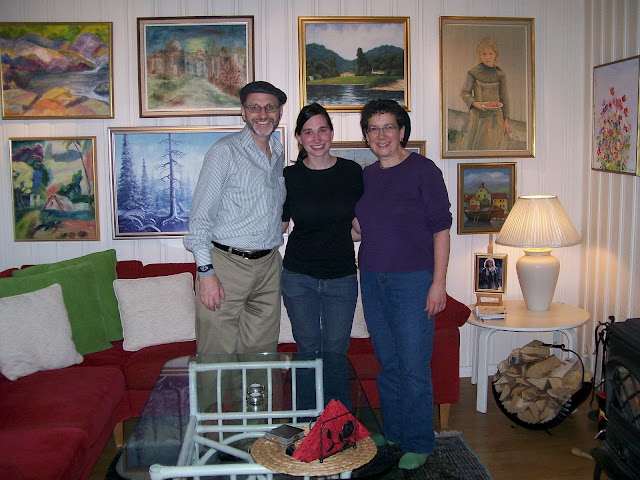
Raheli, Inbar and I henna'ing it up. Because, why not?
After chag we launched into fast-forward mode and zoomed to the grocery to prep for Mimouna. Inbar set to work pounding the dough for the moflettot, and all the Israelis clustered around a laptop, choosing Sephardi songs so we could ululate our way through our post-pesach nosh fest. Finally I went to sleep in the wee hours of the morn, my belly distended with all kinds of chametz yums.

Three hours later I woke to catch my train back to Bergen. Before we started, a Thai family of three moved around the train, looking at seats. I was sitting in a cluster of four facing each other, so I offered to switch and let them all sit together, adding that we’d probably have to switch back when the train filled up in the mountains. They were grateful, and when the mom asked where I was from, and I said America, she nodded and smiled as though that explained something.

As the conductor came by, and then other passengers looking for their seats, I realized I was trying to protect this family. I worried they would cringe before the conductor (what do I know of the Thai personality? Or whether there is one?) or that he and the Norwegian passengers would say “ugh, foreigners,” and I wanted to use my American-ness as a buttress. But it soon became clear that the family was very confident, very self-sufficient, and as I relaxed, I thought, “ah, they’re just like my family.” Then I woke up from my half-doze with a start as I realized that what I meant was, they have the confidence born of money. They travel, they move through the world with ease, because they know that their buck (penger? Thai currency?) will fix it all. Yikes. What heinous classism. I’ll worry about it when I wake up.

Oh, and the whole stretch from Ustaoset to Myrdal is winter wonderland. I forgot, seesawing between Bergen and Oslo as I do, that Norway is actually a cold country. Probably snow here means it’s raining in Bergen.

Hope you’re laughing, Te. This one's for you.

Tuesday, March 27, 2012

Norway: Kid-Tested and Mother-Approved

The adorable apartment they rented

My parents visited me in Bergen last week. Since my dad’s the main reason I write this blog (it’s the first time since I left home six years ago that he actually has a clue of what’s going on in my life) I’m not going to fill you in on the trip in too much detail. Just that I had the most beautiful time showing my parents my life in Norway, tramping along the picturesque streets of Bergen, appreciating the cuteness of Norwegian babies and the gorgeousness of Norwegian men with my mom, and kicking back in our lovely old apartment with a 360 degree view of the fjord and Bergen sentrum.

The first night, I took them to Godt Brød. As I joked around with the cashier, showing off my Norwegian for my mom, his fellow worker behind the counter came over. The first guy beckoned to me. “Look, she’s an American, speaking Norwegian.”

“Yeah, and her name is Hannah.” It was Anita’s son, Evan. Nothing emphasizes Bergen’s tiny size like running into people you know every few hours. Then we bumped into one of my students at Rimi, and the impression was complete.

We went to Café Opera with Anita, and I had that shocking feeling you get when two worlds collide. You see, Anita only met me this year, and sees mature competence, confidence, and creativity (I hope!), where my parents see an adorable yet precocious six-year-old. I didn’t realize how much I regress around my parents until thrust into the presence of a third party, where my character played a funny tug-of-war between its mature self and the kid my parents see me as.

Laundry list: We saw Gamlehaugen, the Fantoft Stavkirk, Kunst gallery, Hanseatisk Museum, Bryggen, the Bergen Domkirk, Fløyen...  while hiking up Fløyen, exclaiming at the beauty of its lushly green trails, we passed a passel of men in their seventies, sturdily hiking up. They enjoyed our presence, offering the tidbit that Prince Charles and Camilla had been up on Fløyen only yesterday—apparently all English speakers should care about British royalty.

I bought kaviar in a tube for my Abba, and brunøst for my Ima. Easy enough to know what they’d each like. They, in turn, brought me Trader Joe's in a suitcase. Sometimes food is love. 

Friday we took the train into Oslo, passing the breathtaking views of fjord and fjell that astound every passenger. One of the best parts of the weekend was introducing my parents to the Oslo Jewish community—to the shlichot who have so comfortably hosted me again and again, and the Norwegian-Israelis who have so warmly welcomed me into the fold. Shabbat dinner at the shlichot we ate with a Tunisian man who had lived in Israel then fallen in love with a Norwegian, and his two sons. The conversation surged through three languages as per usual (only very briefly did my mother and the man speak French, so it really doesn’t count). At one point, discussing the chazzan, my mother asked what he does the rest of the week. Inbar’s answer: “byom shani, hu oseh havdalah bagan.” Hehehe.

Sunday morning my Abba left for the airport. My Ima and I went down to Oslo harbor for tickets on the ferry. It was only when buying them that we realized daylight savings had happened and we’d missed an hour! Luckily, my Abba left in plenty of time, and Oslo airport is small.

The outside of 5 Draggefjelltrappen
We took the ferry to the new opera house, moved through the Munch museum (vastly prefer “Anxiety” and “Despair” to “The Scream,” now that I’ve seen all three, and a silent landscape of snow-heaped firs to those—who knew Munch could paint calm solitude as well as feverish modern angst?), speedwalked the Botanical gardens, and sat for a pleasant while on the Bygdøy shore watching the kayakers after circling around the open-air model Viking village. On the ferry ride back, a father placed his toddler son on the railing near us. The boy was so deliciously cute, waving and calling “mama” to his mother on the lower deck. When he began to stomp on the captain’s roof, the father gently told him, “ikke bang bang.” What a sweet kid, and how perfectly did it exemplify the Norwegian family dynamic.
 
My parents gone, I’ve been feverishly rushing to catch up with everything. Though this morning I did take off for a gorgeous hike up Landås and across to Ulriken. The mud drying in the sun smelled like Monongahela National Park in West Virginia. Vaguely sweet and clean, with the hum of bees accompanying it even when no bees flew. I kept sniffing and thinking of berries. Back home I launched into my frenzy of work: I have to clean for pesach, pack for London, plan my trip to Copenhagen in May, catch up and get ahead on grading and class preparation for the next few weeks, and see the friends I haven’t seen for the past week and won’t see for the next two. Life is deliciously full of good things.


Ready for rain


Alas, the view atop Fløyen
At the top of Karl Johan. Check out that hat.
Showing my appreciation for Wigeland
I may have taught my parents a proper love for Freia
At Akershus Fort, overlooking Oslo's fjord


Bergen the Beautiful

Tuesday, February 21, 2012

Fulbright Forever!

The Bergen crew flew to Oslo Wednesday night, and made it in to the Foreign Office bright and early Thursday morning. The day was a marathon of fascination and dullness: every Fulbrighter presented their research for ten minutes. We started off with the sciences, and then meandered through peace studies over to the Humanities and rounded off with education.
how many Americans does it take to take a picture?

I have to admit, I dozed off occasionally during the morning presentations. There were a lot of graphs, and some pictures of landscapes turned into research zones, and one awesome thing about tracing bacteria on Norway’s seafloors to the moon. Then came peace: two Fulbrighters working at PRIO (the Peace Research Institute in Oslo) studying water conflicts and predictions of conflicts based on computerized collation of newspaper data. That last one garnered quite a few questions about the reliability of the press, but obviously if scanning the news can produce an 80% success rate of predictions, then either the media is much more reliable than we thought, or the news is actually causing crises. I was bothered all the rest of the day by the moral responsibility one must surely incur, knowing a genocide is likely anywhere, but the researcher shrugged off my question about action quite easily by saying they pass on the information to NGOs. Actual prevention didn’t seem to cross his mind for a second, and after all, I suppose we’re dealing with prophecy here, in a way, and so he’s much more concerned with not being charged with manslaughter for failing to predict a war than with actually preventing them.

There is something a bit condescending about Norway focusing so intently on peace research; that outward gaze could be better directed inwards, perhaps. Or maybe that mind-your-own-business approach is simply the apologetic American in me rising up to distance myself from our world-meddling.

When the first humanities people presented, talking about updating Hebrew Studies at U in Oslo, the rise of digital culture, and something that had to do with suspension (our favorite Fulbright in Bergen prof befuddled everyone with large blocks of tiny text on a slide show, each one gloriously disconnected from the last), the Q&A session was quickly shunted into a humanities-vs-sciences stream. There’s been some tension all year, since most Norwegian Fulbrighters are science researchers, and some have only thinly veiled their inability to understand the legitimacy of other work. It was nice to have it out in the open for a moment, even though nobody said anything really new (Karen, the Hebrew literature prof, gave some nice clean hard answers that made me wriggle a bit with joy).

The view from our hotel. Matt, in case you're blalking
(blog-stalking), yep, I stole it from you. Tusen takk!
I was in the very last panel presentation, with Matt, the Oslo ETA, and Isaac, one of the Roving Scholars. Weirdly, even after teaching all year no problem, standing up in front of that group made my hands and voice tremble a bit. After a moment of it I reminded myself that I love to have attention centered on me, and settled down to enjoying my presentation. I tried to keep it entertaining and brief. I started out by dissing Norwegian Jante Law (“this country is smushing the highest and lowest performing students into a sandwich of average that competitive Americans will eat for lunch”), then spoke about sharing my America (that picture of the Ohio toddler flicking off Michigan filled my whole slide), read a bit of the poem that my student who survived Uttøya wrote, and finished up with a replay of the cheider Beit Hamikdash building and destruction. I got enough laughs and thoughtful head tilts to feel it was successful.

Afterwards, we headed over to the American ambassador’s house for a reception. The best part: open bar. I think it’s a sign of how much my life has changed over the course of the year that that was actually exciting. The standing around part was much more fun this time around. The Norway Fulbrighters this year are such incredibly cool, directed, confident people that a weekend with them has rewritten all my previous notions about the anguish of institutionalized programming (thank you NCSY and midrasha). It was weird to chill with them after six months of slowly breaking into Norwegian reserve; we connected so much more quickly, both because of our American openness and through having the same experiences of living as an American in Norway.

Baby skiers! So adorable!
Petter, the Fulbright director, came over to tell me he enjoyed my blog. Eep! After a quick scramble to remember if I’ve written anything incriminating, I smiled and nodded  without giving away which profs were involved in "The Professorial Smackdown" post (he asked). People kept chatting about it all weekend, and now I’m friends with such a large group of the Fulbrighters on FB that you can all be pretty certain you’re getting an abridged version of events. Also, apparently next year’s ETA applicants asked after me in their interviews—I’m so glad they found the blog! Since that was one of my purposes in writing it. And, dude, whoever you are out there that gets Bergen next, be prepared to have the time of your life. 

Friday morning we set off for Lillehammer (yep, that’s the home of the 1994 winter Olympics). The bus trundled past snowy mountain scenery and spent a while beside Norway’s biggest lake, Mjøsa, which was so long everyone assumed it was a fjord until Rena clued us in. It was frozen solid, and there were ice skating paths and ski tracks cut into the snow. I sat in front of Andrea, who’s a veterinarian practicing animal capture techniques for research purposes, and she identified moose tracks for us.

Our ski resort behind Lillehammer showed craggy snow-covered mountains bristling with pine in every direction, adorable red cabins with four feet of snow cupping the roofs dotting their slopes. I kept thinking how, if I had never seen Norway before, it would be just incredible, but at this point it was merely magnificent.

Friday afternoon a group of us walked around for a bit. I got in some laps in the pool before shabbat, and then settled down to a lovely evening of reading and talking in front of the fire. The Fisks, a professorial husband and wife who just arrived in Bergen in January, proved to be darling company, and her good humored delight in landing in Norway while her husband researches gave me a warm glowy feeling. In fact, that was one of the nicest parts of this weekend: seeing the families who had come to Norway together. The older couples snuggling together or skiing in tandem, the reserved Minnesotan family with a high-school aged daughter who seemed so utterly comfortable and content in each other’s company, the Rover Sarah who I think is possibly the Best. Mom. Ever. (okay, so she reminds me of mine) and her husband juggling their young kids. I’ve missed family while I’m out here, and seeing all of these in various stages of life was such a pleasant pick-me-up.

After dinner that night Amanda (Ås ETA), Karen (young Hebrew literature professor) and Ann (probably 60-something-ish year-old writer who presents as both fierce and kind simultaneously (I can say that because we’re not yet friends on FB)) sat discussing the stigma against singlehood for women. It was fascinating to see all of their perspectives. Ann humorously apologized for not solving all that for us years ago, Karen seethed against the assumption that there’s something wrong with single women, Amanda mentioned society’s inability to understand that single women can be happy, and I laughed because I know that when I come home from the most incredible year of my life in which I’m doing work that I find extremely fulfilling, at least one person will ask me about boyfriends. And I have my response all ready: “yes, I found a virile Viking and had a love child with him which I left in Norway because let’s face it, the social welfare laws are better.” Just dare to ask.

Shabbat morning Sarah Johnson (Bergensk flutist) and I went for a walk, and ended up at a small church in the area where the queen of Denmark had bestowed a painting of the ski-slope as a gift. It sits on the altar behind a huge bible, its blue painted landscape quartered by the golden cross that somehow landed on the mountain. I spent the rest of the day alternately reading and dozing and playing bananagrams with the other Fulbrighters—what fun to play with Americans again! I awkwardly made havdalah down in the sitting room because I figured I was less likely to set off the smoke alarm near other candles, but thankfully Joey (Tromsø researcher) was sweet enough to joke about singing the nay-nay-nananay tune and made me feel less weird. Camp Ramah-ers and Bnei Akiva-niks pop up in the most unexpected places.

Saturday night dinner was a formal affair instead of the usual ski-pants and t-shirted proceedings, with each plate costing 500 kroner. It was also annoyingly problematic for me. In the regular buffet, I could just pick out the bits that I can eat and concoct lavish salads for myself. But an appetizer of shrimp followed by a course of deer finished up with some gelatinous-looking quivering blob was not going to work. My table coached our poor waitress through my dietary restrictions and I think heartily enjoyed finishing up my enormous plate after their pathetic three-shrimp servings (probably the chef felt bad that I was just having lettuce and lox, so he gave me a lot of it).

Finally, on Sunday morning, I screwed my courage to the sticking point and strapped on some skis. Andrea and Kirsten (kinesiology researcher studying the effects of stress on young athletes training for the Olympics) helped Sarah Johnson and I with the basics, and we headed out with Sean Taylor and his family (the Minnesotans) onto a cross-country trail. Sean is a ski team coach back in Minnesota, and an excellently patient teacher. When we got to the first hill, he told me to keep one ski a few inches ahead of the other, bend my knees, and keep my back straight so that my body would catch the wind and slow me down a bit. I followed his directions and, to my surprise, found myself zooming down in a glorious adrenaline rush. I couldn’t help it, I let a few whoops out into the countryside. It was such a blitz of happiness. I thought it would be like the time my adrenaline-junkie friend Yoni took me mountain biking (a completely out-of-control near-death experience which still managed to be helluva lot of fun) but weirdly, I have strangely good balance on skis. As a first-class klutz I’d expected to find myself plowing up snow with my nose pretty frequently. Maybe all that time hiking on Bergen’s icy mountains has improved my balance. And lessened my fear of falling.

I think we were all depressed to leave. It’s hard to meet this many awesome people for just a blip and then say bye as they wander off into the fastnesses of the Norwegian wilds for the next few months. Hopefully some of them will drift by Bergen over the rest of our year. Guys, if you're reading this, that's a standing invitation.

Tuesday, December 13, 2011

Weekend of Peace

This weekend I went to Oslo as a chaperone for a Bnei Akiva shabbaton, a gathering of Jewish youth from across Scandinavia (Bnei Akiva is a worldwide Zionist youth organization that I grew up in, and the way that kids across Europe learn about and connect to their roots). Friday morning, I was out the door at 6 am, and after one step promptly landed on my tush. Bergen is slippery this time of year.

I met Ziv, the fifteen year-old who was my excuse for a free ticket, at the airport. We made it to the Oslo shul at the same time as the Dansk contingent, made up of ten or so kids from Copenhagen, who’d come over on the boat with the Danish shlichim (shlichim literally means messengers, and in this case was informal ambassadors from Israel made up of dad, mom, and gurgly baby Aviah who was surprisingly verbal for a 15 month-old and knew who I was after about two tries of “zot Hannah” by her ima). The Danish kids spoke Danish, and Ziv had some trouble understanding them. It seems the lingua franca of this weekend is to be English, and myself the only American in the room.

Friday night was your average shabbaton. Lots of singing, coercive good cheer, power-hungry teenagers windmilling everyone into participation. God, I used to hate these things. I saw my favorite Oslo kid, a curly-headed big-eyed lanky little guy whose every movement is either understated chillness or exaggerated humor (think Clint Eastwood meets a Marx brother). I taught him the Ohio sign, just for the heck of it, and he spent the whole weekend “O-H!”ing me.

Friday night, after activities were over, I went back to the shlichot’s apartment with Racheli and Inbar (the Oslo shlichot), the Copenhagen shlichim, and Yonatan, the guy in charge of Bnei Akiva shlichim in Scandanavia (he’s based in Stockholm). There they hashed out the situation of world Bnei Akiva today, how to deal with the communities they’re working in, why the rabbis of these tiny European communities stay and don’t go back to Israel (as Yonatan said, here they can be certain that they’re doing something important, and almost nothing tops that), and how to handle the culture clashes they face. How to both influence and respect the traditions of the communities they’re plopped into. Honestly, listening to them speak, I kept thinking that Americans would make much better shlichim than Israelis, because they can understand secular Jews better. Obviously, the whole point is bridging that culture gap, so my idea is ridiculous, and yet an Israeli who has lived their whole life in a Jewish bubble can understand so little of what’s happening in these Norwegian kids’ lives, that in some ways I think it makes sense.

Shabbat morning I met Amanda (the Ås ETA, went to Dublin together) outside the shul. She’d been curious and wanted to see services. We went in together, and I had that weird mind twist one gets when seeing one’s own world through another’s eyes. I noticed the beauty of the congregation singing together, and the adorable children trooping up to the bimah to sing adon olam, and the intensity of the story of Dina’s rape, as though I was seeing it all for the first time.

At kiddush, people kept assuming Amanda was Jewish, which was fine except when the husband of the American attache here in Oslo said something about so many of the Fulbrighters being Jewish and how we’re always being brilliant disproportionate to our numbers. Awkward dose of Jewish exceptionalism—I half expected him to pull out that list that shows how many Nobel Prizes we’ve got and match it to our .03% of world population, but he blessedly didn’t.

The kids in the shabbaton had a discussion with the chazzan of the community, an Israeli who’s lived in Oslo for a year. They asked great questions, about free will and God’s omniscience, Christians not keeping the rules of the Old Testament, and the reasons for kashrut. I cringed and cringed again as he explained things from his religious Israeli perspective, as he placed ultra-orthodoxy top on a scale of righteousness, gave an answer about the new testament that began with his never having read it, and explained that he keeps kosher because it’s his blueprint for life. It was when he was making a hash of free will that I jumped in and gave the kid the obvious philosophical answer about God being outside time in the simplest English I could drum up. They kept looking at me after that, expecting me to give a real answer after the frum Israeli equivocation, but I kept quiet, just thinking that it’s no wonder Scandinavians don’t want to be frum, their only model for it is the obnoxious Israeli presumption of having all the answers. Americans would definitely make better shlichim.

Shabbat lunch was a hilarious round of all the camp lore I know and love. We stood up on our chairs singing “I’m gonna be a pizza man,” did rounds of “ivdu et Hashem,” and the gang of little siblings at the end of the table led us in “Yibaneh Hamikdash.” Bnei Akiva lives!

Karl Johan in December
Shabbat ends so early here that we had a half hour break, and then it was time for seudah shlishit. The singing was all on a very high key, but then we had havdalah. That was, truly, beautiful. Incredibly sonorous and sway-y and just gorgeous ritual.

Walking down to Domkirken with Amanda, we talked over the day and religion in general. She’s got a thoughtful perspective on everything. She’s never read Anne of Green Gables, but is a kindred spirit nonetheless. At the Domkirk, we met up with other Fulbrighters—Sean and his wife and daughter from down in Kristiansand, Andrea, Ted from Trondheim, Sarah Anderson (the roving scholar who’s come to Bergen twice and possibly changed my life as much as anything else this year through conversations about education), and her daughter Kaila, who is the most thoroughly with-it ten-year-old I’ve ever met. Some of them I remembered from orientation, some of them I really thought I had never seen before, but all of them were interesting and, in that indefinable way, “good people” people.

In Youngstorget we amassed behind banners that read, “More Women, More Peace.” People up on the balcony were speechifying, but we didn’t listen much until one woman shouted into the microphone: “Black! Gifted! Not weak! Not afraid!” It was both incredibly awesome and kind of as though she was thumbing her nose at the western crowd who had deigned to bestow a peace prize on such talent. While we’re on the topic, how wonderful that this was the year that women’s rights activists were recognized? Though cramming them all in together like that, as though we want to get all the women out of the way before we can get back to men, kind of ticked me off.
 
The people on the podium stopped speaking, cuing the end of our chatting. Slowly, the crowd began to move forward. As we crossed the road back towards Karl Johan, people in vests at either side of the avenue held torches up, and the crowd slowly lit their candles at the torches and then passed on beneath the ribbons of Christmas lights and the night’s stars. It was an incredible, glowing flow of be-mittened humanity. I bet Ted five kroner that someone’s hair would catch fire by the end of the night—all that enthusiastic flame in the crowd.

We neared the Stortinget and gazed expectantly up to the balcony of the Grand Hotel. The doors opened to give the crowd the impression of action, and after a few false starts, Ellen Johnson Sirleaf, Leymah Gbowee, and Tawakkol Karman came out to the sound of roars from the crowd. We shouted, and they waved. Then the noise died down, and they waved again, and once again we screamed our approval at them, at the world, our endorsement of peace. I snuffled up tears as we watched them bow to the crowd. Mostly, when you get this many people clapping, it’s at a basketball game or when a Republican says something really stupid. But this was cheering for peace. A massive celebration for peace. You can see the video here.

Gbowee, Karman, and Sirleaf, from left to right
Check out the dynamic between Sirleaf and Karman; always fun to watch the dignified fight with the crowd-pleaser.

The one thing that bothered me a bit was that, after all, this was in Norway. And Norwegians just don’t whoop and holler  all that well. These women have accomplished incredible things, the least we can do is yell for them a bit. I grabbed Kaila and together we war-whooped and aiaiaiaiaied and cat whistled into the candle-lit night, giving the women the ovation they deserved. The truth is, Norway is… too peaceful. The last war they had was when the Germans invaded them a little bit seventy years ago. So perhaps they can be excused from lacking enthusiasm—without seeing war, how can you appreciate peace?

Afterwards, we met more Fulbrighters back at Sarah’s for a party. Her husband had cooked up a storm of traditional Norwegian Christmas food, including lefsa, apple cake, and something that looked like butter soup called rommegrøt. He’s playing househusband for the year and definitely exhibiting some Friedan-like symptoms: perhaps it’s not the feminine mystique so much as the staying-at-home-without-a-career mystique.

I got back to Bergen with no voice, and a cheider class to teach in an hour. So I cleverly jotted down some of the main points of chanukkah, stuck some knickknacks in a bag, and told the kids that they had to find a way to perform the story of chanukkah using all the stuff in the bag. That kept them busy the whole time, and then we all enjoyed a chanukkah play, traditional-style. Two of the dads were there, too, and I found it touching how one told me that both his sons say Kiddush every Friday night, no matter what. He really wanted me to know they had some connection to their roots.

Gløgg
I taught my last class of the year this morning. Anita brought in Christmas treats: pepperkaker (christmas cookies), clementines, and gløgg (A Norwegian holiday drink much like mulled wine with raisins, nuts, and spices) to start off the class, and explained that we were having Christmas early because this was my last class before I left. Anna raised her hand in quick panic—“wait, are you… are you coming back in January?”
“Yep, I’ll be here until the summer. You guys are stuck with me until June.” Then, they surprised me. They started to clap. There was a fierce burst of applause for about five seconds. I was startled, and rather emotional. I’m not sure how it feels to be a nobel peace laureate with all of Oslo applauding you, but standing at the front of that classroom with my students clapping to hear I’d be back gave me a warm yummy feeling that had nothing to do with the smell of gløgg.
Happy holidays and happy New Year, everyone. 

Saturday, October 1, 2011

Rosh Hashanah: Oslo Edition

Two of my high school students tried to come in the window of the classroom this morning. As they hung like pendulums with their bellies on the windowsill, heads in the classroom and legs still kicking ridiculously outside, I meant to tell them to go around and use the door properly, but I missed. Okay, actually I was laughing so hard I couldn’t summon up the words. Luckily Anita was there to direct them to the door. Isn’t it wonderful to teach high schoolers and be a part of their maturing process?

We read a short story about society and the individual. Man are these some smart kids; they each had articulate opinions about responsibility and ethics. I brought up bystander effect and it electrified them. They all had examples of their own or thought about what they would do in like situations. Most charged were A’s words about an individual’s responsibility to society. I felt, behind the usual desire to say something intelligent in class, an urgency to communicate that her friends’ deaths at Utøya had given her more responsibility, given every single person more responsibility, to their fellow human beings.

After class, she stayed to talk with me a bit. She’s very close with R, the girl in the class who survived Utøya, and R hung around on the edges of our conversation. I know she’s been having trouble returning to normal life. Finally, as A and I wound down our conversation, R wrote something in huge letters across the chalk board. What does it mean?, I asked her. It’s the political slogan for her party, she told me. Tell me more, I told her. Before that, she’d been like a child who desperately wanted to get my attention, but didn’t know how, and since I don’t speak Norwegian, I hadn’t been able to crack in. But now, as she and A told me about the party and their positions in it, I felt her open. I think, I hope, it helps… I know that regular teenage angst is greatly allayed by adult attention, and if the horrors that she went through can be relieved by any similar means, I’m going to ply her with all I can.

In Amlit I burst out laughing, because while explaining Mark Twain, Ingrid said, joking, “I don’t see no p’ints about that frog that’s better’n any other frog.” You haven’t heard a fake Southern accent until it’s mangled through the soft, hesitant, slightly British tones of a Norwegian. I thought I was going to fall out of my seat. Last class, everyone shrieked because while reading Emily Dickinson’s “I Heard a Fly Buzz When I Died” one intrepid member of that species zoomed its way into the classroom. Literature is never dull.

On the plane to Oslo this morning, I thought about how comfortable I feel here. Living in another country is just a matter of smoothing the edges of that culture over your own skin, softening out the places where it puckers or rubs or juts sharply into your shoulder. But not every culture has a shape that I could fit myself inside of so easily.

In the Americans-in-Norway Facebook group, there was a discussion comparing America to Norway. People debated health care stubbornly (on the one hand, everybody has it and you needn’t be rich to use it, but on the other, it’s paid for by tremendously high taxes) for most of the thread. But I found some of the other points interesting, and am rephrasing the ones that I agree with and adding my own:

Norway:                                                                                              America:
Better chocolate                                                                           More of a produce selection
Roaming Law (you can pitch tent anywhere for three days)               Empty hiking trails
No separation of Church and State, but no God either                        Picturesque Bible Belt
Charming, history-filled cities                                                             Free bathrooms
Less public drunkenness                                                                     MUCH cheaper alcohol
Politeness                                                                                            Volunteering spirit

Trivia of the day: if an ICA and a Rema are next to each other, it spells America backwards.

I’ve started using a Norwegian detergent, and my clothes smell sweet and Norwegian.

I’m in Oslo for Rosh Hashanah. One of the things I’ve been wondering is how such a small Jewish community supports itself. Today, I found out—war reparations. Pretty much all of Norwegian Jewry was shipped off to camps during the war (in Norway, WWII is still called “the war” because there have been none since then. Hear that with longing, Israelis. Hear that with shame, Americans), and the Jewish community here uses the interest from the reparations to keep itself going. Wonderful as it looks from the outside, it’s so terribly sad that instead of the vibrancy of an old Jewish community that struggles to keep itself going, there’s this bits and pieces of a community kept going on plentiful blood money. Wish it was the other way around.

Rosh Hashanah in Oslo has been interesting, and largely lovely. I’m staying by the shlichot, who are the two people in this country having the experience most parallel to mine this year (yes, my shlichut is for America, mah meshanah?). It’s nice to compare notes with them. The davening was beautiful, albeit occasionally more pompous than I’m used to. A chazzan came in from Israel, and community members harmonized with him. At one point, his daughter, sitting next to me in the balcony, and several of the women, picked up the higher parts and everyone below turned to listen to the female half of the choir.

The first night, I ate dinner at the annual Israeli dinner and sat with a fun gay Argentinian couple who made aliyah recently and are traveling through Scandinavia for a month. Lunch was at the old age home next to the shul. The residents spoke only Norwegian, with tiny chunks of scattered Yiddish and English, so the room stayed pretty quiet. I walked around trying out my Norwegian, but sat next to a man who spoke English. Into the silent room he shouted that his parents had been murdered in the war, that he had fled to Sweden, returned to Oslo after, worked in the chevra kadisha for fifty years, but he didn’t believe in God. Then we sang “bashanah haba’ah” together, and I helped him clap on beat.

That night, I walked down to the Akker Brygge alone. As I passed Karl Johann, two drunken Norwegians started tailing me. There were a lot of people around, so I wasn’t scared, but kept a courteous and dismissive expression so that they wouldn’t take offense or start anything. Then one of the men put his hand on my coat. He didn’t grab me, just tapped my shoulder for a moment. All I did was look at him. He slunk away. Funny how an unwanted touch instantly galvanizes me into a person that's incredibly scary and ready to lash out in defense. Unfunny how so many of my female friends are held captive in their houses after dark by fear of such an experience.

 
I passed the Nobel Peace Center. Outside of it stood a walk-through exhibit. As I approached, I realized that the pictures of dusty empty streets had captions describing dehumanization in Gaza, and the West Bank. The captions sidled and slipped around the truth, telling half-facts and showing photos zoomed in close without showing the larger picture. Every tourist to Oslo walks past this area, and sees this propaganda. An ugly feeling settled in my stomach as I squinted through the lies. 

The Akker Brygge was quiet. I followed the string of fountains down to the wharf, and out onto an empty dock. On either side of me, boats sagged against the wall. A ladder led down into the lapping black water, and I pondered slipping in for a moment, as I always do when on a dock. In the distance, eating up my Rosh Hashanah ambitions and introspection, a green light mocked me by blinking cliché across the water. So I returned to Bergstein.

For lunch the second day, one of the families invited the greater part of the Jewish community to a huge meal. I met a couple who work at the US embassy and had already heard of me (you know, the other Jewish American in Norway) from the Fulbright staff, a family from Christiansand who converted two years ago and were ostracized by their former friends, and people who asked me again and again what on earth I was doing in Norway, and why I wasn't Israeli since I was speaking Hebrew. After lunch we all sang classic songs together, a small enclave of Israel in the middle of Oslo.


At lunch on shabbat I sat next to the security guard for the Oslo shul. She's the woman who interrogated me the first time I entered the shul. Getting inside the Jewish community center for an hour was harder than getting into Norway for the year. She's getting a degree in international relations, and had strong opinions about immigrants taking over European countries' identity. I suppose, if my job was to sit day in, day out, behind bullet-proof glass and inspect visitors for potential threat, I might also have a cynical approach.


The shlichot and I watched Savta Chaya Maitah after shabbat. It's an iconic early Israeli comedy whose hero reminds me strongly of Napoleon Dynamite. Tomorrow I take the train back to Bergen, armed with a block of kosher cheese bigger than my face. A good way to start the year. 

Thursday, September 1, 2011

Språk Åpner Dør: The Hegemony of English

Språk Åpner Dør: The Hegemony of English
Norwegian Poetry
On Monday I dropped in for lunch at the Fulbright office with my matpakke –literally, “food package”. I’ve heard that travel agents tend, as a profession, to be the happiest people in the world, because they spend their lives planning vacations. The Fulbright staff fulfill the generalization liberally. Not only do they help people go on the most incredible year-long vacations, they fund them and tack on lifelong prestige just for kicks. Everyone in the Fulbright office seems pretty happy, and correspondingly pleasant.
Managed to walked straight past Norli’s (the Norwegian equivalent of Barnes and Nobles) as I came back from Karl Johansgate without even a peek inside since the prices here make me choke, but was outwitted by an adorable little quaint second-hand shop further down the road, and spent an hour browsing.
Met Rebekka, the Jewish Norwegian who hooked me up with the community here, and her husband Tyson for coffee in one of two kosher cafes in Oslo—check that, in Norway. They are the most completely lovely people I’ve met yet. After, we walked down to the Vigeland Sculpture Garden in Frogner Park, where lots of statues of naked people lined the paths, some in rather more pleasant poses than others. An enormous monolith of writhing bodies looms over the whole park, an eerie phallic construction of human angst. A fountain of huge muscular men supporting an overflowing basin of water was my favorite; the sculptures, with legs braced against the weight behind a curtain of water, kindled a sense of the raw power of mankind. (The latent and well-squashed Ayn Randist in me flickered up).  
On the way back, I dropped past Ibsen’s grave. I’m falling in love with the cemeteries in Norway; I’m not yet sure I could live here, but I’d really like to be buried here!
Tuesday I met Matt, the Oslo ETA, two Fulbright staffers, and the three Rovers (Roving Scholars: profs who roam Norway dispensing their American-grown wisdom to the Norwegian masses) at the Oslo train station. On the way to Halden we picked up Amanda, the third ETA, who’s living in Ås, a small town right near Oslo. My big regret about this year is that the three of us aren't in the same city; they are both completely awesome in exceedingly different ways. We reached the Fremmedspråksenteret, the National Center for Foreign Language Teaching. Its slogan is, “Språk Åpner Dør,” language opens doors.
The office staff began by introducing us to English’s status as not a foreign, but a second language in Norway. The difficulty, they said, was in encouraging people to learn another language after English. Even as a part of me jumped up and down that so many people can access the intricate loveliness of Virginia Woolf and Elizabeth Barrett Browning, I was swamped with fear at realizing the project of cultural imperialism upon which I am embarking. I am not just teaching English, I am playing with reality and power. My students will recognize Hemingway, the Beatles, and 9/11 instead of Proust, African drummers, and the Mumbai attacks. Their minds will learn to phrase the world they see in English adjectives like elegant, revolting, and fan-fucking-tastic instead of whatever subtleties of understanding other languages would bestow. Language is so bound up with power, it sometimes makes me feel guilty about being an English major: while everyone laughs at me for my probable lack of earning power in the future, I’m playing with the tools they use to define their dreams. Teachers of language decide what deserves to be given meaning in the human lexicon, and how we access that meaning. They manipulate your very ability to understand your own thoughts. “Gentle Reader, the Word will leap upon you with leopard man iron claws” –William Burroughs knew. 


Cafe and Bookshop in Oslo:
has readings and literary nights
Okay, done taking myself so seriously. The director of the center didn’t go into any such subtleties as these. She explained the Norwegian school system to us, and gave us a tour of the facilities. Matt found a book titled Learning Under the Influence and I promptly decided to make it my go-to textbook. Another staffer talked about how Spanish is the most popular language to learn in Norway, German the most economically practical, and Arabic on the rise. They used slide shows that talked about “Research and Dissimination” and “Shool in Norway,” and a Rover discussed the “Fulbright ETA contingency”—meaning not some future possible event in which we ETA's take over the Fulbright Foundation, or possibly Norway as a last resort, but our group. I pondered the way in which authority and fancy slides cloak total incompetence-- well, not total incompetence, but the sort on a level with Bachmann's gaff about Elvis' death date. In fact, I discovered early on that as long as my posture is good, I can say just about anything and people will consider it authoritative. A rigid spine and carefully cocked head is the secret to success.

I returned to Fantoft and a text from my friend Juliet (French): “if you are interesting I found planetickets oslo-paris, 66euro in dec! =) X Also, goodfellows klubfantoft 10 minutes.” Regardless of whether I get to Paris in December, I went to the movie and watched a bunch of Europeans’ conceptions of America get even weirder. 


Tuesday, August 30, 2011

A Weekend in Three Languages


Thursday was a mixture of exhilaration and bummeritude. In my morning class with the adults, I stole friends’ facebook updates to explain American reactions to the earthquake (watch out what you guys write about the hurricane! All’s fair in love and teaching!), which my class loved (they liked yours best, Zev, and Tali R’s about pj’s).

Chilling outside the Stortinget (Parliament)
In the afternoon, I chewed my tongue to shreds in a poorly taught Masters English class on 19th C lit and science. There were only ten of us in the room, but nobody said a word except the prof, who bored with basic background on the Victorian era and the generally unfriendly relationship between the sciences and humanities. And she talked about science and lit in 19th C Britain without mentioning In Memoriam. Grrr. After four years of the fierce intellectualism in UMD lit classes, I was disappointed. At the beginning of the class, I ventured a tiny joke; the prof was talking about science’s pride in being a modernist endeavor and based on facts. I laughed—“how lucky we in the humanities are to be past that—postmodernists don’t have any idea what the hell is true.” But nobody laughed, so I decided to play the shy European and shut up.

That evening I got a call from Ronen, an Israeli from Oslo. He asked me to teach cheder in Bergen (calm down, Americans, it’s not the black-and-white ghetto photos of five kids with payos bent over a book that you’re picturing, it’s just Sunday school). One of the cheder teachers is moving to Stavanger, and another has a three month exchange in Copenhagen coming up, so there is only one left. I couldn’t say anything but “sure!” to their desperation, and got a nice reward; they flew me into Oslo for the weekend for a training seminar. Yaysh! The past two shabbatot have been lovely—lots of time to walk, and read, and sitting on the lawn with new friends, but I jumped at the chance to spend shabbat with a real Jewish community.

Odelia and I: there's a fountain behind us
Friday morning Odelia (half Norwegian, half Israeli) and I flew to Oslo—the other two Bergen teachers, Ettie and Thea, followed later. Thus began our plunge into linguistic confusion. Odelia speaks Hebrew and Norwegian, so we communicated in Hebrew. Thea speaks Norwegian and English, so we spoke English. Ettie speaks all three, and the Bnei Akiva shlichot whose apartment we stayed at speak the same languages as me, with opposite degrees of skill. Most of the people in the community are Israeli, so their default when with each other is Hebrew. Finally Joav, the rabbi, delivered an ultimatim: English as the lingua franca. Which everyone promptly ignored. I got to use the word “hobson jobson” over and over, but only in my mind—not even the other half-American raised in New York would have recognized it.

Oslo Akker Brygge
It was very lovely to drop into the warmth of the Jewish community. Also fun to see the shlichot, who had only arrived on Monday, work through the same culture shock as myself, except that they were taken care of by the community who properly understood exactly where they came from. It was fun to be in a shul again, and to speak Hebrew. Hilariously, I was more in place than anyone—unlike the other cheder teachers, I’m used to the synagogue routine, and unlike the shlichot, I’m used to Diaspora Judaism. Friday we were told there was to be a big Kiddush because the children who had been in summer camp would all be gathered for a reunion. Michael, the Norwegian who I met with in Israel a few months ago to find out about being Jewish in Norway, had run the camp. He gave us a tour of the synagogue/community center, and we helped him prep the room. He thanked us by saying, “thank goodness there are girls here to deal with the decorating.” The nice thing about gender progressiveness in Norway is that whenever I get tired of it I can just visit the Jewish community.
Oslo Synagogue

Friday night we trickled into the women’s balcony in the old, ornate shul. The shlichot headed straight to the front, leaving the five nonreligious Israelis/Norwegian Jews with us who hadn’t been in shul in a decade to sit uneasily in the back. I suppose I’m more used to helping nonreligious people feel comfortable in shul than two kids from Jerusalem and Kiryat Gat, so I sighed at the kiruv-y role I really didn’t want to play and issued page numbers and warnings to sit or stand. The shlichot will learn.

Shul seen from the women's balcony
Shabbat day, the shul was crowded as families came with their children. Adorably, the children sang parts of the davening like a little lisping choir. The boys crowded around the chazzan’s shtender, and the girls lined the railing of the of the balcony. I kept thinking about how earlier in the week I’d been teaching Benjamin Franklin and his distaste for the way religion turns out good Christians instead of good people (well, he wrote “good citizens,” but he meant good people, because today patriotism is as suspect as religion). Now I was right back in shul. It felt good to sink into the familiar, even into the parts of the familiar that disturb me. Spiritually, I’m very happy to be the only one praying within a 200 mile radius, but socially I’d rather be hit on by Israelis.

Thea and I out with the whole young Jewish
population of Oslo. We fit in one booth.
When the Rabbi stood to give his speech, I had a dizzying moment where I thought perhaps he wasn’t actually speaking but only gabbling at the community for fun. Then I caught the words “kommer til Jerusalem å spiser” –come to Jerusalem to eat—and knew that he was speaking a real language. The Rabbi, who everyone calls Joav, possesses as little of the rabbinic instinct for pompous despotism as I’ve ever seen—he reminds me of Rabbi Backman from Maryland.

Caviar in a toothpaste tube. So gross!
We ate lunch at his family’s apartment, along with Ronen and his children and a visiting Israeli family whose father had been born in Norway. English, Hebrew, and Norwegian surged through the room in waves, channeled by some people and only lapping around the feet of others depending on their education. After, we returned to the community center and Joav and Michael discussed Jewish education in Norway, which is mostly informal. Then we returned to the shlichot’s apartment for a community seudah shlishit in which people invariably opened by speaking in Hebrew, heard my accent, stared, and asked where the hell I was from and what the hell I was doing in Norway, then congratulated me on my good Hebrew.

I’m sure that after this weekend, I’ll spend a hilarious amount of time saying “slichah—sorry—beklager” before I get it straight, but that’s okay; better too many languages in my brain than the pure American monolinguism that most have. I’ll be back in Oslo in a month for Rosh Hashanah, and this time I'm taking the train: stay tuned for pictures of "the most beautiful train ride in the world."